Running a small business in today’s competitive market is not easy. Customers are increasingly using Google, social media, websites, and online reviews to discover products and services. This is why digital marketing for small business has become an important part of building visibility, attracting customers, and increasing sales.
Whether you run a local shop, service business, startup, or growing company, the right digital marketing strategy can help you compete with larger businesses without requiring a massive marketing budget.
What Is Digital Marketing for Small Business?
Digital marketing is the process of promoting your business through online channels such as search engines, social media, websites, email, online advertising, and content.
For a small business, digital marketing can help you:
- Build a strong online presence
- Reach potential customers
- Generate quality leads
- Increase website traffic
- Improve brand awareness
- Build customer trust
- Increase sales and conversions
The biggest advantage is that small businesses can target specific audiences instead of spending money trying to reach everyone.
Why Is Digital Marketing Important for Small Businesses?
Traditional advertising can be expensive and difficult to measure. Digital marketing gives small businesses more opportunities to reach the right people at the right time.
For example, when someone searches for a product or service that your business provides, appearing in search results can bring that person directly to your website or business profile.
A well-planned digital marketing strategy can help your business establish credibility and stay connected with customers throughout their buying journey.
1. Build a Professional Business Website| Digital Marketing for Small Business
Your website is often the first place potential customers go to learn more about your business.
A professional website should clearly communicate:
- What your business offers
- Who you serve
- Why customers should choose you
- Your products or services
- Contact information
- Customer reviews or testimonials
- A clear call to action
Your website should also be mobile-friendly, fast, easy to navigate, and optimized for search engines.
2. Use SEO to Get Found on Google| Digital Marketing for Small Business
Search Engine Optimization (SEO) helps your website appear when people search for relevant products and services.
For small businesses, local and industry-specific SEO can be particularly valuable.
Some important SEO activities include:
- Keyword research
- Optimizing website pages
- Creating useful content
- Improving page speed
- Building relevant backlinks
- Optimizing local business information
- Adding descriptive title tags and meta descriptions
Instead of simply trying to attract more visitors, focus on attracting people who are actually interested in what your business offers.
3. Take Advantage of Local SEO
If your business serves a particular city or local area, local SEO can help customers discover you when they search for nearby businesses.
Keep your business information consistent across important online platforms and encourage satisfied customers to leave genuine reviews.
For example, searches such as “digital marketing agency near me” or “best bakery in [city]” often indicate strong purchase intent.
Local SEO can therefore be an effective way for small businesses to attract nearby customers.
4. Grow Your Business Through Social Media
Social media platforms give small businesses a way to communicate directly with their audience.
Depending on your target customers, you can use platforms such as Instagram, Facebook, LinkedIn, YouTube, or other relevant channels.
Instead of only promoting your products, create content that provides value.
You can share:
- Educational tips
- Behind-the-scenes content
- Product demonstrations
- Customer stories
- Short videos
- Frequently asked questions
- Industry insights
- Offers and promotions
Consistency is usually more important than posting large amounts of content occasionally.
5. Create Valuable Content
Content marketing can help establish your business as a trusted source of information.
For example, a small fitness business could publish articles about workout routines, nutrition basics, and fitness tips. A digital marketing agency could create content about SEO, social media marketing, website optimization, and online advertising.
Useful content can attract people who are searching for answers and introduce them to your brand.
Over time, content can also support your SEO strategy and bring organic traffic to your website.
6. Use Paid Advertising Strategically
Organic marketing can take time. Paid advertising can help businesses reach potential customers more quickly.
Platforms such as Google Ads and social media advertising allow businesses to target audiences based on factors such as location, interests, search intent, and demographics.
However, small businesses should avoid spending money without a clear strategy.
Before launching an advertising campaign, define:
- Your target audience
- Your campaign objective
- Your budget
- Your offer
- Your landing page
- Your key performance indicators
Start with a manageable budget, measure the results, and optimize based on performance.
7. Build Trust With Online Reviews
Customers often look for reviews before making a purchasing decision.
Positive, genuine reviews can help potential customers feel more confident about choosing your business.
Encourage happy customers to share honest feedback and respond professionally to both positive and negative reviews.
Remember that online reputation is not just about collecting reviews—it is also about consistently delivering a good customer experience.
8. Use AI to Improve Your Marketing | Digital Marketing for Small Business
Artificial intelligence is becoming increasingly useful for small businesses.
AI tools can assist with tasks such as:
- Content ideas
- Social media planning
- Market research
- Customer communication
- Data analysis
- Video creation
- Keyword research
- Marketing automation
The goal should not be to replace creativity and strategy with AI. Instead, use AI to save time, improve productivity, and support better marketing decisions.
9. Track Your Digital Marketing Results |Digital Marketing for Small Business
One of the biggest advantages of digital marketing is the ability to measure performance.
Important metrics may include:
- Website visitors
- Search traffic
- Leads
- Conversion rate
- Social media engagement
- Advertising costs
- Cost per lead
- Sales generated
Tracking these numbers helps you understand what is working and where your marketing budget should be focused.
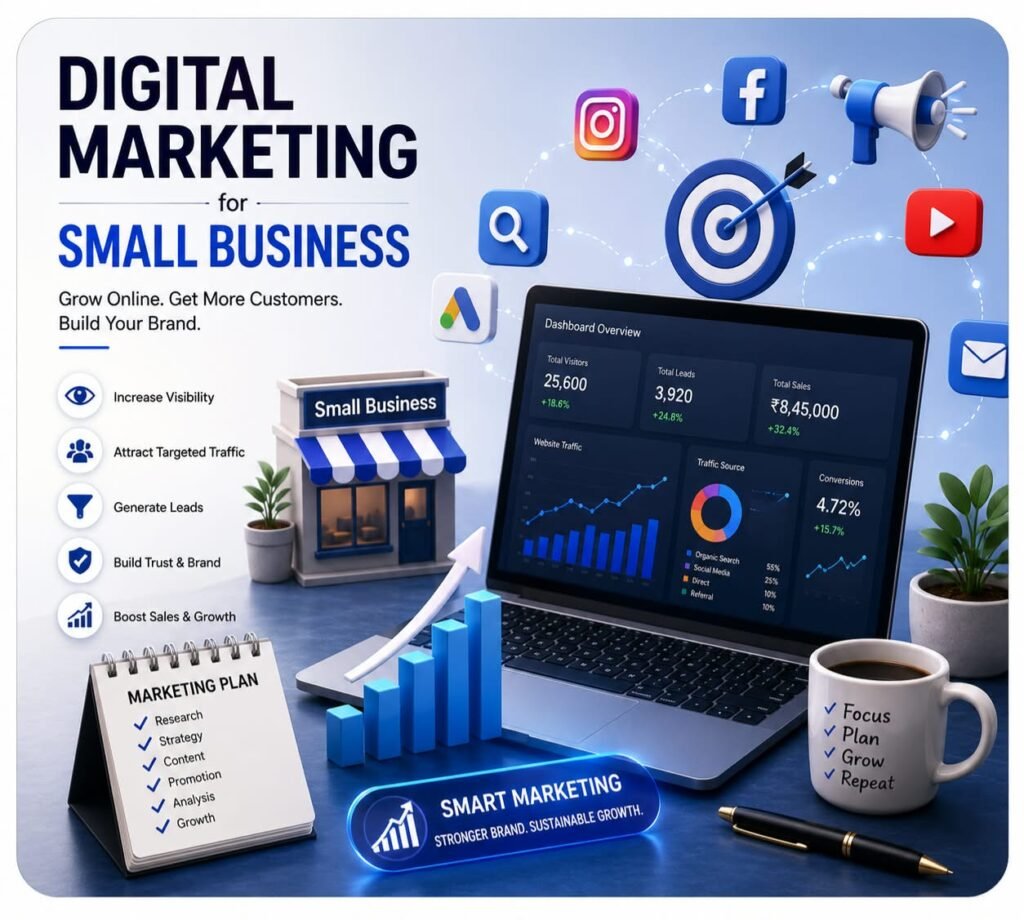
How Much Does Digital Marketing Cost for a Small Business? Digital Marketing for Small Business
There is no single price for digital marketing. The cost depends on your goals, industry, location, competition, and marketing channels.
A small business may begin with a focused strategy such as:
SEO + Local SEO + Social Media + Content Marketing
Once the business starts generating consistent traffic and leads, it can expand into paid advertising, email marketing, video marketing, and other strategies.
The important thing is to focus on return on investment rather than simply spending more money.
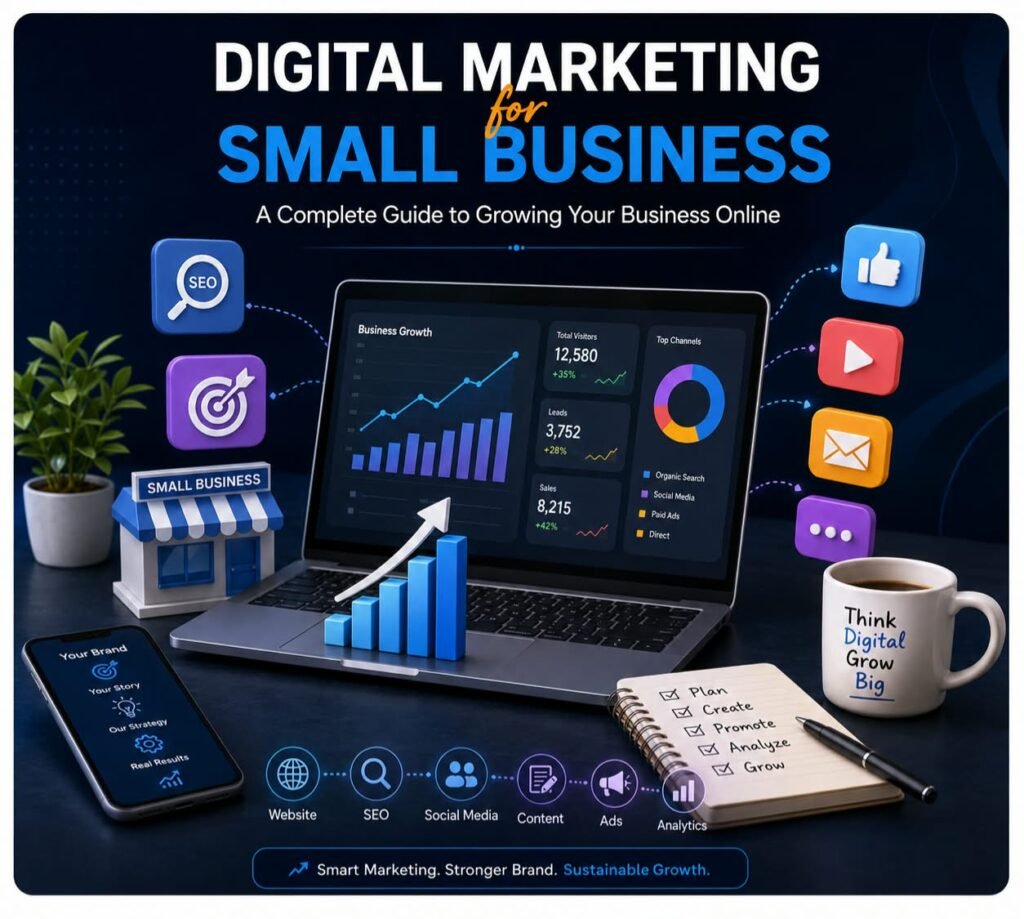
Common Digital Marketing Mistakes Small Businesses Should Avoid | Digital Marketing for Small Business
Many small businesses make the mistake of trying to do everything at once.
Some common mistakes include:
- Targeting everyone instead of a specific audience
- Ignoring SEO
- Having an outdated website
- Posting inconsistently on social media
- Running ads without tracking conversions
- Creating content without understanding search intent
- Ignoring online reviews
- Focusing only on followers instead of customers
A focused strategy is usually more effective than trying to be everywhere at the same time.
A Simple Digital Marketing Strategy for Small Businesses
If you are just getting started, follow this basic approach:
Step 1: Define your ideal customer.
Step 2: Build or improve your business website.
Step 3: Research keywords related to your products or services.
Step 4: Optimize your website for SEO and local search.
Step 5: Create useful content consistently.
Step 6: Choose the social media platforms where your audience is active.
Step 7: Test paid advertising with a controlled budget.
Step 8: Track leads, traffic, conversions, and sales.
Step 9: Improve your strategy based on real data.
Final Thoughts
Digital marketing for small business is no longer just an optional marketing channel. It can be a powerful way to build visibility, connect with customers, generate leads, and grow a business in a competitive market.
The key is not to use every available marketing channel. Instead, identify where your customers spend time online and build a focused strategy around those channels.
With the right combination of SEO, local SEO, social media marketing, content marketing, paid advertising, AI-powered tools, and data-driven optimization, even a small business can build a strong digital presence and create sustainable online growth.
If you want to strengthen your online presence and turn digital traffic into real business opportunities, a clear strategy is the best place to start.
Conclusion | Digital Marketing for Small Business
In today’s competitive online world, Digital Marketing for Small Business is one of the most effective ways to build brand visibility, attract the right customers, generate quality leads, and increase sales. From SEO and local SEO to social media, content marketing, paid advertising, and AI-powered tools, small businesses have multiple opportunities to grow online.
The key is to choose the right strategies, understand your target audience, consistently provide value, and track your results. With a focused and data-driven approach, even a small business can build a strong digital presence and achieve sustainable growth.
Start with the strategies that match your business goals, stay consistent, and let your digital presence become a powerful engine for long-term business growth. Digital Marketing for Small Business